Refractory Aggregates Compared: Tabular Alumina vs Calcined Alumina
Refractory formulators face a recurring choice when specifying high-alumina castables and bricks: should the aggregate be tabular alumina or calcined alumina? Both materials are high-purity aluminum oxide, yet they differ fundamentally in production method, physical form, density, and performance in service.
This comparison provides the technical data needed to select the right alumina-based refractory aggregate for your specific application — with real specification values and clear selection guidance.
What Is Tabular Alumina?
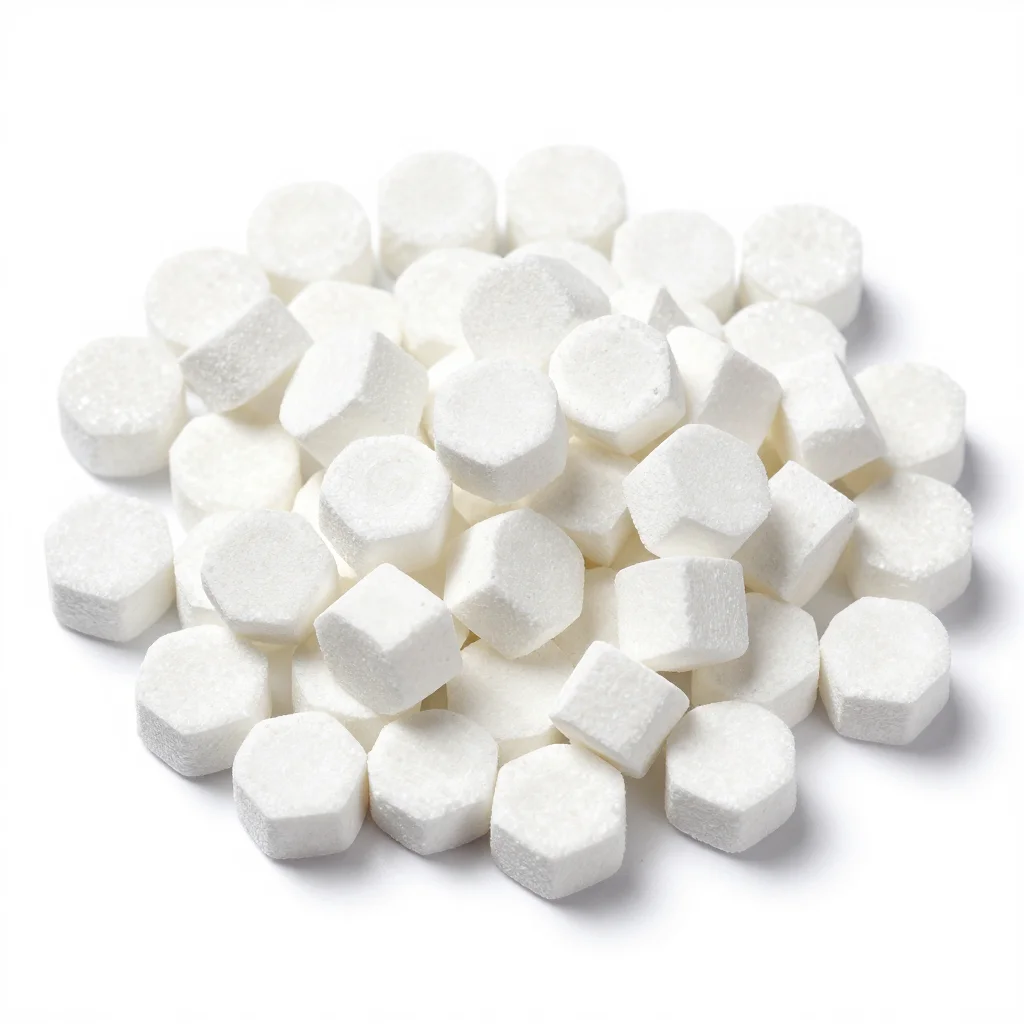
Tabular alumina is produced by sintering calcined alumina at extremely high temperatures (1,800–1,900°C) in a shaft kiln. The extended sintering causes the alumina particles to densify and form large, well-developed tabular (plate-like) α-Al₂O₃ crystals with closed, spherical pores.
The result is a dense, coarse aggregate with:
- Al₂O₃ ≥99.5%
- Bulk density ≥3.50 g/cm³
- Water absorption ≤1.0%
- Particle sizes from 0–0.5mm up to 8–15mm fractions
Tabular alumina is supplied as graded aggregate — coarse chunks and granules suitable for use as the primary aggregate in refractory castables, bricks, and precast shapes.
What Is Calcined Alumina?
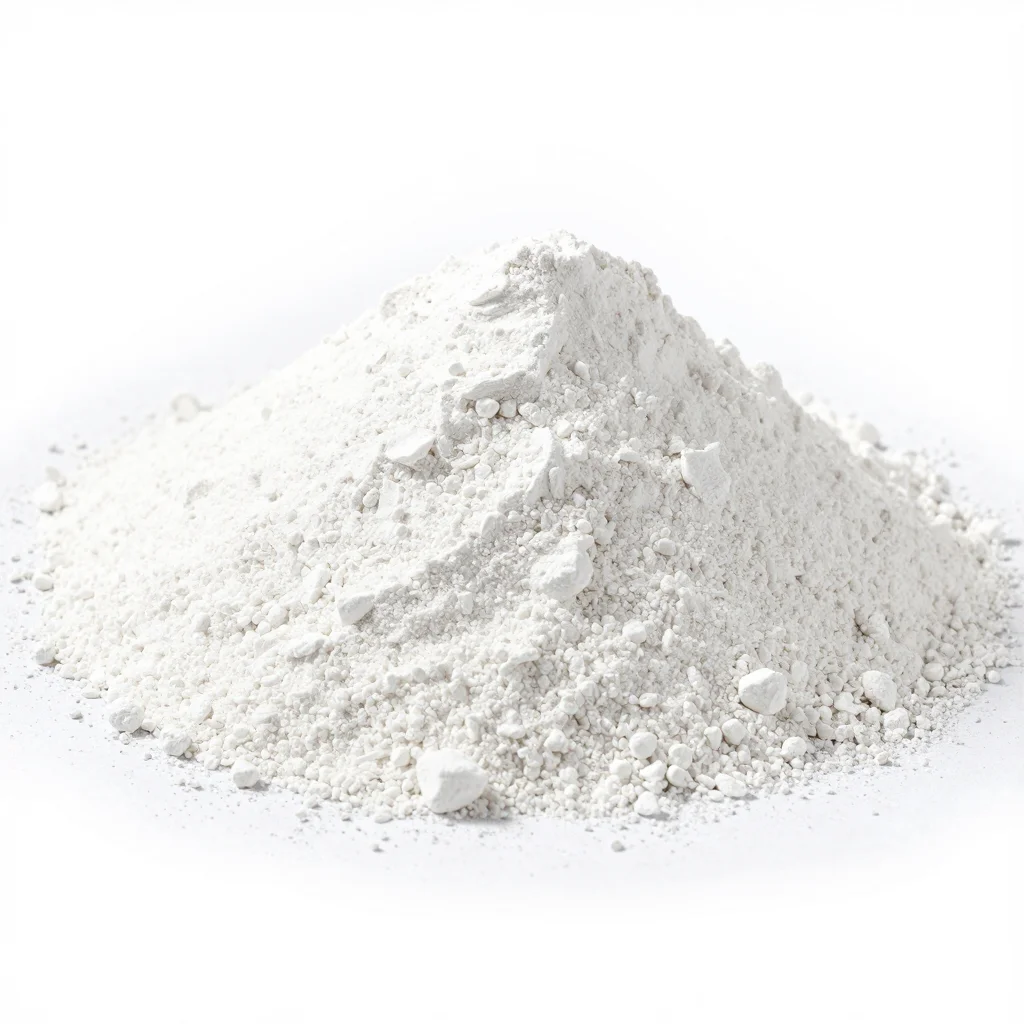
Calcined alumina is produced by heating aluminum hydroxide (Al(OH)₃) or alumina trihydrate to temperatures of 1,100–1,500°C to drive off chemically bound water. The result is a fine powder consisting primarily of γ-Al₂O₃ or α-Al₂O₃ crystals, depending on the calcination temperature.
The result is a fine powder with:
- Al₂O₃ ≥99.0%
- Median particle size: 1–80μm (varies by grade)
- Na₂O ≤0.4%
- Powder form — not a coarse aggregate
Calcined alumina is used as a matrix component in refractory formulations (filling the voids between coarse aggregate particles) and as a raw material for producing other alumina products including tabular alumina itself.
Key Differences
| Property | Tabular Alumina | Calcined Alumina |
|---|---|---|
| Al₂O₃ content | ≥99.5% | ≥99.0% |
| Physical form | Coarse aggregate (granules) | Fine powder |
| Bulk density | ≥3.50 g/cm³ | N/A (powder) |
| True density | ~3.95 g/cm³ | ~3.95 g/cm³ |
| Particle size | 0.5mm – 15mm fractions | 1–80μm |
| Water absorption | ≤1.0% | N/A (powder) |
| Crystal phase | α-Al₂O₃ (fully converted) | γ-Al₂O₃ or α-Al₂O₃ |
| Production temperature | 1,800–1,900°C (sintering) | 1,100–1,500°C (calcination) |
| Typical use in refractories | Primary aggregate | Matrix / binder phase |
| Relative cost | High | Moderate |
Form Factor: Aggregate vs. Powder
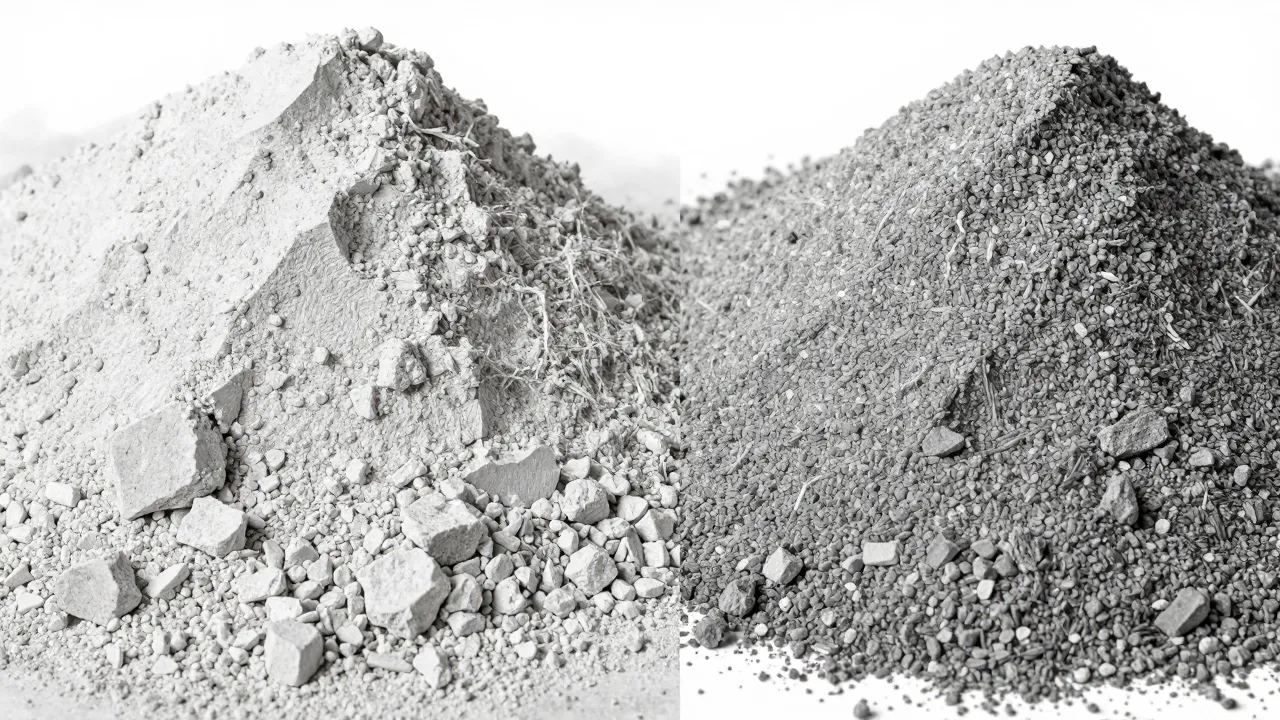
The most fundamental difference is physical form. Tabular alumina is a coarse aggregate — granules ranging from 0.5mm to 15mm. Calcined alumina is a fine powder with particles measured in microns.
This means they serve different functions in refractory formulations:
- Tabular alumina: Provides the structural backbone of the refractory — the coarse aggregate that gives the castable its strength, density, and volume stability
- Calcined alumina: Fills the matrix between aggregate particles — improving density, reducing porosity, and contributing to ceramic bonding during firing
They are complementary, not competing, materials. Most high-performance low-cement castables use both: tabular alumina as the aggregate and calcined alumina as the matrix powder.
Purity
Both are high-purity materials, but tabular alumina edges ahead: ≥99.5% vs. ≥99.0% Al₂O₃. The difference comes from the additional high-temperature processing that tabular alumina undergoes, which further drives off volatile impurities.
For most refractory applications, both purity levels are more than adequate. The purity difference only matters in the most demanding applications (semiconductor process equipment, ultra-high-purity ceramics).
Cost
Tabular alumina costs significantly more than calcined alumina due to:
- Higher processing temperature (1,900°C vs. 1,500°C)
- Longer processing time (hours of sintering vs. hours of calcination)
- Energy-intensive shaft kiln operation
However, both are used in different quantities — tabular alumina as the primary aggregate (60–80% of a castable formulation by weight) and calcined alumina as the matrix (5–15%). The per-ton cost difference is less impactful than the total formulation cost.
When to Specify Tabular Alumina
Use tabular alumina as the primary aggregate in refractory formulations for:
- Steel ladle castables: Hot-face linings exposed to molten steel and slag at 1,600°C+
- Precast refractory shapes: Burner blocks, well blocks, impact pads
- Low-cement castables (LCC): Where maximum density and strength are required
- High-alumina bricks: Premium bricks for severe-service applications
- Slide gate and nozzle refractories: Precision-cast components requiring thermal shock resistance
Tabular alumina’s density and low porosity are essential in these applications — no other alumina aggregate matches its combination of purity and density.
When to Specify Calcined Alumina
Use calcined alumina as the matrix component in refractory formulations:
- Low-cement castable binders: Fine alumina powder reacts with calcium aluminate cement to form ceramic bonds
- Refractory mortars and ramming mixes: Powder component that provides plasticity and bonding
- High-alumina ceramics: Raw material for technical ceramic production
- Insulating castables: Fine powder fills voids to reduce thermal conductivity
Calcined alumina is also the raw material for producing tabular alumina — it is the starting point that gets sintered into the coarse aggregate.
Combined Use: The Optimal Approach
The best refractory formulations use both materials together:
Example: Low-Cement Castable Formulation
| Component | Weight % | Material |
|---|---|---|
| Coarse aggregate (5–8mm) | 25% | Tabular alumina |
| Medium aggregate (3–5mm) | 20% | Tabular alumina |
| Fine aggregate (1–3mm) | 15% | Tabular alumina |
| Matrix powder (0–1mm) | 20% | Tabular alumina fines |
| Fines (<45μm) | 10% | Calcined alumina |
| Cement | 5% | Calcium aluminate cement |
| Additives | 5% | Silica fume, dispersant |
This formulation uses tabular alumina for the aggregate skeleton and calcined alumina for the fine matrix phase. The result is a dense, strong castable with excellent slag resistance and thermal shock performance.
Purchasing Considerations
Tabular Alumina Specifications
- Al₂O₃ ≥99.5%
- Bulk density ≥3.50 g/cm³
- Water absorption ≤1.0%
- Na₂O ≤0.4%
- Particle size fraction (specify exact range)
- Fines content below minimum screen size ≤5%
Calcined Alumina Specifications
- Al₂O₃ ≥99.0%
- Na₂O ≤0.4%
- Median particle size (D50): 1–80μm (specify exact grade)
- α-Al₂O₃ conversion percentage: affects sintering behavior
- Loose packed density: indicates particle packing efficiency
Frequently Asked Questions
Can I substitute calcined alumina for tabular alumina?
Not directly. They serve different functions. Tabular alumina provides coarse aggregate structure; calcined alumina is a fine matrix powder. Substituting calcined alumina for tabular alumina would produce a castable with no aggregate skeleton — essentially a cement paste, not a refractory. If you need to reduce cost, consider using a less expensive aggregate (such as BFA or bauxite) and reserving tabular alumina for critical hot-face layers.
Why is tabular alumina so much denser than fused alumina?
Tabular alumina is sintered, not fused. The sintering process causes solid-state diffusion that eliminates porosity and produces near-theoretical density. Fused alumina is crushed from a cast block, producing irregular shapes with micro-cracks and internal porosity. Tabular alumina’s closed-pore structure is inherently denser.
What particle size of calcined alumina should I use in castables?
For low-cement castables, calcined alumina with a D50 of 2–5μm is standard. This fine particle size provides good packing efficiency in the matrix and contributes to ceramic bonding. For conventional castables, a coarser grade (D50 20–40μm) may be sufficient. The optimal size depends on the total particle size distribution of the formulation.
How do these compare to fused mullite for refractories?
Fused mullite (70–77% Al₂O₃) offers better thermal shock resistance than either tabular or calcined alumina due to its lower thermal expansion coefficient. However, it has lower slag resistance than high-purity tabular alumina. Mullite is preferred in cyclic-temperature applications; tabular alumina in steady-state high-temperature, slag-exposed applications. See our fused mullite guide for detailed comparison.
What is the shelf life of these materials?
Both tabular alumina and calcined alumina are chemically stable and have essentially unlimited shelf life when stored dry. Calcined alumina powder may absorb moisture over time, which can affect flow properties in castable formulations. Store in sealed bags in a dry environment. If moisture absorption is suspected, dry at 110°C for 24 hours before use.
Ready to Source?
Tabular alumina and calcined alumina are complementary materials in high-performance refractory formulations. Specifying both in the right proportions is key to achieving optimal castable density, strength, and service life.
Request tabular alumina quotes for coarse aggregate and calcined alumina pricing for matrix powder — we supply both with COAs and consistent quality across production lots.